Thursday, May 25, 2006

Local Ownership for Philadelphia Newspapers Not Necessarily Good News-- Nor Bad News

That faction of the universe that holds that big media conglomerates are bad for journalism should take no comfort in the announcement Tuesday that a group of Philadelphia investors will buy The Philadelphia Inquirer and Daily News from McClatchy, flipping it from the Knight-Ridder acquisition. The event is, by itself, neither positive nor negative.

In some quarters there is a nostalgia for “local ownership” of the media. The superficial rationale is easy to understand. Local ownership presumably means that decisions are not made in some far off corporate building by executives more interested in profits that Pulitzers.

But as I have been writing for decades, local ownership not only is not a free pass for better service to a community but may actually be a step backward. The case of Philadelphia is the perfect example. Indeed, I was astounded, though pleased to see, for the first time in my memory, that The New York Times’ report on Wednesday actually included a brief history of the vindictive ownership of The Inquirer before the Knight chain bought it:

Walter Annenberg, a wealthy businessman whose family owned The Inquirer from the 1940's until the late 1960's, used The Inquirer to settle personal scores, promote his own political views and crush his business and political rivals.

Annenberg treated The Inquirer as an arm of his own will," said John Morton, a newspaper industry analyst….

The other -- and dominant -- paper in Philadelphia during the 1950s and 1960s was the Evening Bulletin, owned by the McLean family. The Bulletin was a decent if bland paper. It took localism seriously. Indeed, while working for a weekly alternative newspaper in the early 1970s we did a spoof of The Bulletin, highlighting the provincial outlook of the paper with the banner headline “Six Philadelphians Die in New York Nuclear Holocaust.” The accompanying article focused on these six and their Philadelphia neighborhoods, while noting in passing the supposed elimination of the entire city of New York. It was our take on the effects of a local perspective all the time.

The Inquirer, as accurately characterized in The Times article, was also locally owned, but used as a personal organ by Annenberg. When the Knight chain—headquartered in far-off Miami—took over, The Inquirer became more professional, addressing regional issues and trends, investigating city government, bolstering its national and international coverage and especially developing investigative reporting. Meanwhile, The Bulletin only became more neighborhood oriented. It died. The Inky, and its feisty tabloid relative, the Daily News, survived, though in recent years it’s declining circulation—an erosion of 18% over 10 years —has taken its toll on the resources and therefore quality of the editorial.

The new owners, including an advertising/pr executive, the head of a publicly owned home building company, a union pension find and other investors with a local connection—have no publishing experience. That is not necessarily bad, if they recognize their limitations and adhere to their promises to keep hands off editorial decisions. But in the end that is almost impossible. They need to keep the papers reasonably profitable, to keep up both salaries and plant and equipment and, in the case of the union, preserve the pension payments for its members. While they may refrain from deciding on what political candidates to endorse or subjects to investigate, they will have final say over budgets, which means staffing and resources.

The new owners, incorporated as Philadelphia Media Holdings, might be wonderful. Or they might end up being meddlesome, voicing displeasure with an article critical about Toll Brothers (the holding of the largest single investor) or some other interest of one of the major stockholders. I have made the argument elsewhere that there is something to be said for owners who run media properties as "merchants" rather than as "missionaries."

My message is that local ownership is not, by its very nature, desirable, any more than a geographically removed corporate owner is, by its very nature, undesirable.

Link to this entry
E-mail this entry

Thursday, May 04, 2006

"Trust in Media" survey adds to data that no firms dominate U.S. news media

The “Trust in Media” survey conducted by the BBC, Reuters and the Media Center released today has something in it for almost anyone. It found that the media were trusted a bit more than governments, Fox News was the most trusted news source in the U.S. Al Jazeera most trusted in the Middle East and the BBC (surprise?) most trusted globally. Blogs, says the report, are the least trusted form of news, with 25% of respondents finding them trustworthy. (Actually I find that surprisingly high, as by their very nature blogs are much like op-ed columns, expected to have a point of view).

But if you only read the headline and the executive summary you miss out on much of the nuance of the survey. From where I sit, it is yet another data point (see many others in my media competition study), that the media in this country is more diverse and competitive than anywhere else on the globe.

Here’s my analysis.

Although the headline says that Fox News, by a fraction over CNN, is the most trusted source in America, that turns out to be a plurality of only 11%. The third most trusted source, ABC News, was named only by 4%. That is, the other 74% split their answers among dozens of others. Unlike the U.K. or Germany, newspapers are predominantly local, so large numbers of people no doubt identified their local newspaper as their source, fragmenting the cited sources.

The table, culled from the survey’s report, shows the considerable disparity in American media versus several other nations. Among the 10 nations surveyed, only India had a profile similar to the U.S, where the most oft cited source (AAJ TAK) was also as low as 11%,

Most trusted specific news sources mentioned spontaneously
Source: Compiled from BBC/Reuters/Media Center Poll: Trust in the Media


One could interpret these finding several ways. A cynic might say that no American provider instills much trust. In the U.S., local newspapers were considered slightly more trustworthy (mentioned by 81%) than national television (75%). But overall, the media in the U.S. get higher trust scores than in the U.K. or Brazil, and about the same as Germany. In the U.K., television news is trusted by only 55% of those surveyed, but that is almost three times as much trust as in newspapers (19%). In Brazil, national newspapers and television are viewed about equally, though overall lower than in the U.S. (about 68%). Germans have the highest trust component, with public radio, television and newspapers all cited by about four-fifths of respondents.

Conclusion: If one is worried about the “power” of individual media owners or programmers, then the “Trust in Media” survey should help ease such concerns. In the UK one third of the audience believes in the government-controlled BBC. In Brazil, privately held Rede Globo holds the faith of over half the population. In the U.S., trust is fragmented. It is a positive sign for diversity of content that there are no dominate, pervasive sources of news and information, public or private.

Link to this entry

E-mail this entry

Friday, March 17, 2006

This week's FCC fines for indecent content of TV broadcasters just a cost of doing business

You may have seen on Wednesday that the FCC fined CBS as well as some local broadcasters a total of about $4 million for violations of decency standards. This included instances of violence as well as impermissible sex.

Though the headlines were about the fines, the broader subtext is about equity: First Amendment equity. The larger issue is the double standard that is applied to broadcast television—even though only a handful of households even obtain their signal via traditional broadcast—is different than that applied to the other hundreds of channels we can view. Any programming that does not start out life from a broadcast station has the same First Amendment privileges as the print media. In short, the boundary is obscenity and libel. Broadcasters have a tighter reign, called indecency.

Adam Thierer has a concise review of the history of the legal rationale for why programs on television have fewer content rights than others. If it was cable network ESPN that carried the 2004 Super Bowl in which Janet Jackson had her infamous “wardrobe malfunction” there would have been no cause for FCC action. But it was broadcaster CBS, and it was hit with a $550,000 levy. In today’s video world, such a distinction is ludicrous.

The time is right to level the playing field for content. Broadcasters, however, will need to pay a price to buy themselves out of what Thierer describes as “asymmetrical regulatory policy that unfairly singles out one set of speakers [i.e., broadcasters] relative to all others.” The asymmetrical regulation is an artifact of three rationales created by Congress and the courts: 1) spectrum was perceived as scarce, 2) broadcast signals were considered “pervasive” and 3) in return for being allowed to use this scare spectrum broadcasters had to serve in the “public interest.” So the bargain was free spectrum in return for some public service obligations.

In the last 15 years or so, however, the level of public service obligations eroded. The fairness doctrine has been rescinded, as have old regulations on network ownership of programming and prime time access limits. Despite the recent fines, the scope for sex and violence on broadcast programs is far more liberal today than 20 years ago. In effect, just about the only limit today’s license holders have is the modern boundaries of indecency, a boundary that is restrictive only when compared to the nearly anything goes content permitted print and non broadcast video.

In 1996 the broadcasters could have bought their way out of their asymmetry. That was when they lobbied hard and successfully to be given new spectrum to make the transition to digital from analog. A few lonely voices in Congress, Sen. Robert Dole being the most prominent, thought it was time to make broadcasters pay for the spectrum the same way satellite providers, cell phone operators and the like all must bid for the spectrum they use.

There should be a price for broadcasters to win full First Amendment rights

Broadcasters want it both ways. The cable operators had to invest tens of billions of dollars to build and upgrade their systems. DBS providers have to launch satellites and often subsidize user hardware beyond the TV set. Broadcasters have none of these expenses. (In reality most broadcasters today have paid for their spectrum in buying it from someone else, but that is not relevant here). Broadcasters have also been given the benefit of “must carry” rights on cable and DBS, whereas nonbroadacst networks must negotiate with those carriers for a space on their systems. In many cases they also must pay dearly to get such carriage.

To remove all content restrictions specific to broadcasters, as logical as it seems when looking at the greater freedom of everyone else in the video universe, should not be a one-sided deal. It would seem that symmetry would be achieved only when broadcasters must pay for their transmission pipeline the way their competitors do and negotiate with the cable and DBS providers for carriage. Then it would be equitable to admit that their remaining public service obligations are moot and content regulation can be made a level field with other video providers.

My guess is that when push comes to shove, broadcasters would be willing to put up with their few limits on content if the alterative was paying billions for spectrum and losing their must carry rights. If content equality is really important to them, then they could go to Congress and offer to give up their current benefits in exchange for a level playing field. In the meantime a few hundred thousand dollars here and there is simply one of the costs of doing business.

Link to this entry
E-mail this entry

Friday, March 03, 2006

The "non-media monopoly" as seen by the smart money

Among the worst performing publicly owned companies over the past three years are a collection of media companies, all associated with the popular misconception of “media monopoly.” This turns into an oxymoron when these so-called monopolies have such poor financial performance that they are among the bottom of the barrel among all sorts of competitive companies in other industries.

The reason we have laws prohibiting business monopolies (dating back to the 1890 Sherman Antitrust Act) is that capitalist economics don’t work when there is no competition. Prices can be set higher than they would be if there were competitors in the market. This pricing effect starts to be measurable even before there is literally one supplier: an oligopoly, where two or three suppliers dominate a market, can also set prices higher than they would be in a competitive market.

I count myself among a handful of voices that not only hold that all the trends and forces have been moving media in the opposite direction—away from concentration-- and back it up with empirical research, not merely a handful of anecdotes and speculations of what “could” happen. Adam Thierer has added more data in his Media Myths in contrast to the rhetoric of the “sky is falling” crowd.

In the case of the media, the most vociferous of those who fear concentration of ownership in few hands are not particularly concerned with the economic consequences of ownership. Indeed, Ben Bagdikian, in his book The Media Monopoly, does not discuss the economic concept of monopoly at all. According to the index of the fourth edition, he devotes part of two pages to a discussion of profits. He, as well as Robert McChesney and other critics make their argument on the presumed negative influence on civic discourse and culture that could be an outcome if a handful of individual owners did indeed set the agenda and determined what we all read, heard and viewed.

But there is a nexus between the two concepts of monopoly. Because if there were in fact a handful of big media companies that precluded competition in the marketplace of ideas, that would be reflected in the success of those same entities in the marketplace for products—the economic marketplace. That is, if you and me and everyone else could only go to Time Warner, News Corporation, CBS, Gannett, Disney, Bertelsmann, Viacom, Clear Channel, Comcast (geez, it gets to be a long list for a concentrated industry…) then presumably these companies would be raking it in. Can a small number of media companies—out of tens of thousands that are players in the U.S. alone— be truly dominant without that translating to the bottom line?

So let’s go to the ticker tape. Last year Adam Thierer and Dan English published a paper, “Testing ‘Media Monopoly’ Claims: A Look at What Markets Say” that I wrote about in September. They asked “If the media market were indeed full of monopolists, wouldn’t a lot of people be investing in media stocks?” In brief, Thierer and English found that Time Warner, Viacom, News Corp., Clear Channel, and Comcast lost a combined 52 percent of their value (in terms of market capitalization) over the previous five years.

The latest evidence along these lines is the recent compilation in The Wall Street Journal identifying the best and worst performing stocks (subscription required). Among the 50 poorest performers were six media companies, four with major holdings in the fading newspaper segment, but also two major broadcasters, including the largest owner of radio stations. Among the best performing media companies were younger and thus more volatile entrants.

Worst and Best Performers, Total Return, Past 3 Years
Source: The Wall Street Journal, Feb 27, 2006, R1. Compiled by L.E.K. Consulting LLC.

Although one might criticize Wall Street as being obsessed with last quarter's and the next quarter's earnings, over the longer haul the financial markets tell a story of substance. Out of 76 industry sectors (from home construction to computer hardware), the publishing industry was 72nd over the three year period, broadcasting and entertainment was 63rd. This is not the stuff of a concentrated industry ownership. Time to move on.


Link to this entry
E-mail this entry

Saturday, February 04, 2006

Why Being Big Means Little: The Lessons for Media Businesses from Western Union

On January 27, 2006, Western Union sent its final telegram, 150 years after it sent its first. There’s a bit of a message for the media industry in this historical footnote.

In the late 19th century and into the 1930s, Western Union was the pinnacle of the communications business. Indeed, believing that telegraph was the be all and end all of communications technology, Western Union turned down the offer to buy Alexander Graham Bell’s telephone patents in 1876 for $100,000. (They soon realized their mistake and actually hired Thomas Edison to develop a telephone device, which he did. But Bell’s fledgling company won a patent infringement suit against the giant Western Union which then withdrew from voice telephony).

But Western Union thrived for a time, even as the Bell System overtook it in size. In 1900 Western Union sent 63 million telegrams. In its peak year, 1929, it handled 200 million telegrams. Telegram service was slowly eroded by the increased availability and decreasing price of long distance voice. But it also lost market share as teletypewriters were introduced, a newer technology that did not require skilled Morse code operators. Much later, facsimile spelled the end to what was left of the telegram’s commercial market. In the past year 20,000 telegrams were sent, mostly as novelties or as formal notifications.

What does this say to and about the media industry? Western Union, at one time the monopoly national communications company, was co-opted by new technologies. Though profitable for many years after its heyday, it’s decline brought it to bankruptcy and rebirth as a money transfer service—a very different business. Even then, it was blindsided by an upstart, PayPal, as the first mover in the Internet money transfer business. Its belated response, Bidpay.com, closed shop the end of 2005.

So the lessons, once again, are, first, that bigness guarantees nothing when it comes to the future, even when at one point a near monopoly. (The same could be said for AT&T, which survives in name only because Southwestern Bell, the company that bought the remains of the old Ma Bell in 2005 and assumed the AT&T name.) Previously I wrote about how none of the 10 largest retailers in the U.S. in 1962 were around 30 years later. Second, just because newer technologies and players don’t ruin a business or an industry overnight that doesn’t mean that a long decline, with occasional ups amidst the many downs, is in progress. Finally, even when a player does make a strategic move into a concentric market (as W.U. did from electronic text to electronic money), the game is not necessarily won. For the moment, Western Union still has a decent business transferring money internationally. But newer players, such as PayPal, are nipping at its heals.

The media industry was much like banking for the first seven decades of the 20th century, staid and predictable. Newspaper publishers knew exactly who their competitors were—other newspapers. Broadcasters knew that once they got their sinecure from the FCC they were set. Book publishers came and went with easy entry and exit, but with the “security” of knowing that “the book” as a format was forever. Hollywood studios understood that the bottleneck of distribution and marketing would keep the number of major competitors manageable.

But all that is out the window (or, perhaps, Widows), much as is the old telegram. Newspaper circulation continues its decades long slide. Knight Ridder reports lower earnings each quarter. Television networks are making their hit shows available for download the day after broadcast. Some Hollywood movies are released on DVD and cable the same time as in the theater. Podcasts and vodcasts come from regular folks and media heavyweights alike. Radio emanates from satellite and the Internet. Video on demand fills 42” high definition screens—and 3” cell phone screens.

Where will you be the day your hometown daily newspaper ends its print run or the TV listings start to show only the names of new programs available each day, not the time they are on?

Link to this entry
E-mail this entry

Monday, January 02, 2006

Is there a need for public broadcasting in the mega channel world?

Is there a future for public broadcasting in the U.S.? Last month a blue ribbon panel headed by former Netscape CEO James Barksdale and former FCC Chairman Reed Hundt took a stab at addressing this in a report, “Digital Future Initiative: Challenges and Opportunities for Public Service Media in the Digital Age.”

As the title indicates, there are no dearth of challenges for public broadcasting. In the Foreword they write: “Our nation’s media marketplace is becoming increasingly fragmented and on-demand…. If today’s public broadcasters can successfully adapt to this new environment, the potential for enhanced public service through digital media is vast…”

The report is a fine inventory of needs. But it fails to ask what should have been the initial premise: Is there a need for a publicly funded media entity today?

Timothy Karr, though a supporter of publicly funded media through the self-styled media reform advocacy group Free Press, has been quoted as agreeing that “PBS has a problem supporting programs that are competitive in today's commercial market.” Then why the need, with all continuing political controversy that has accompanied publicly funded media?

The report goes on to identify areas they believe could sustain a need for public service media (expanded from the original 1967 legislation of Public Broadcasting). Much of the report centers on educational needs. “Emerging digital media technologies hold great potential as educational tools,” the authors tell us. But after identifying the sorry state of education today, they add “We believe that in the digital future, all Americans should continue to be able to depend on public broadcasters to furnish them with the reliable, unbiased information they need in the course of their lives.

Sure there are educational needs, but there are local state and federal programs to address these needs. Yes, the public needs reliable and unbiased information, but has that been provided by public broadcasting? And more to the point, are there mechanisms for the public to get the information they want and need without it going through a publicly funded enterprise?

The question at hand: in today’s highly competitive, multichannel world, is there a need for publicly funded media, particularly TV? The historical argument for publicly funded media has been that there were few channels for TV. Commercial broadcasters would not tackle hard issues, controversial topics, or quality children’s programming.

This must be balanced against policy issues of real or imagined political pressure, real or imagined content biases, and the actual cost—from taxes or tax-like fees.

The money is not really the issue. All told in 2003 public broadcasting had revenue of $2.3 billion. Federal appropriations for public broadcasting is about $400 million, which account for only about 16% of the total budget. The rest comes from foundations (7%), business underwriting (15%), state governments (14%) and a smattering of university, local government and contracts.

The question is really about priorities and feasibility. What can public media bring to the party that is not now being provided by the History Channel, the Biography Channel, the Discovery Channel and the like, not to mention the bottomless pit of content—much available for the taking—via the Internet?

Indeed, the very audience that these taxes and foundation dollars goes to support is the audience that can most afford cable subscriptions, broadband connections, DVD rentals and purchases as well as being most likely to have the skills needed to find the information they want. Public media’s core constituency, as described by the public broadcasters’ own promotions are “affluent, influential, educated, discerning, and diverse. They are the decision makers and opinion leaders…” Central Michigan Public Television claims that its audience penetration “runs deeper into upscale households than any other medium. According to surveys conducted by Roper Reports, public television viewers have high incomes and are likely to have invested in stocks, bonds and mutual funds.”

The “Digital Future” report may have started from the wrong base. If they need to work so hard at finding a role, then maybe it is time for public broadcasting to sunset itself. Indeed, the Digital Future panel could have started out with this point of view: If a public media organization did not exist today, what are the compelling arguments that would rally the public to support the creation of such a service?

If public television disappeared tomorrow in the US, mostly a small elite would notice. Today, unlike 20 or even 10 years ago, there are alternative structures to a public media organization if there is a constituency for some type of content or service that doesn’t now exist. The best of what PBS provides will be quickly picked up by existing or new channels, sites or whatever. “Sesame Street” would not evaporate nor need to hawk sugared cereal to survive. Democracy would not be threatened. Civic discourse would not see a ripple.

Link to this entry
E-mail this entry
Wednesday, December 14, 2005

Family Friendly cable package? Not so voluntary and not good policy

Can an action be "voluntary" if one is coerced into taking the action? Adam Thierer has an insightful take on volunteerism as it applies to the recent announcement by the cable industry that it will offer so-called "family friendly" packages, or tier. I urge you to read his entire post. In brief:

  • How voluntary is this action when Congress is making regulatory noises and the FCC is holding Time Warner and Comcast hostage in awaiting overdue approval for their purchase of pieces of the bankrupt Adelphia Cable?

  • There isn't any evidence to suggest there is much of a demand for such a package. DirecTV offered a 10 channel package a few years ago for $5 per month and had so few takers it eliminated it.

  • The cable operators have less latitude than we think. Often it is the program suppliers who insist on contracts requiring that the cable operators include their small networks as a condition for carrying their more popular networks. That makes cherry picking networks for a tier problematic.

  • Who is going to determine what is "family friendly?" Adam suspects "Cable operators are setting themselves up for a major catfight with many programmers who will insist on being part of the new tier. 'Hey, my channel is family-friendly too!' many programmers will exclaim.'"

I agree with Adam that if there was a consumer demand for such a package the cable folks-- who after all are always looking for another opportunity to squeeze a few more dollars from their fixed cost network-- would have found a way to offer this truly by choice. Cable subscribers who don't want to expose themselves or their kids to any programming already have the tools to lock out such channels, creating their own individualized "my family friendly" menu. That's even better than Comcast or Charter trying to decide what should be there.

It's not surprising why the politicians love this issue: It plays well with their constituents even if they don't really find it helpful. And it has no budget consequences. Doesn't get much sweeter. A pity it's poor economics and even worse policy.

Link to this entry
E-mail this entry

Monday, December 05, 2005

A la carte pricing for cable? A bad idea for diversity.

It’s clearly silly season at the FCC. Among other things, they are chatting up unbundled pricing for the cable industry. A very bad idea. Who says so? Well. Steve Yelvington, for one, who is no lackey of the cable industry. And not just because it would undo the industry’s business model with little gain for consumers. No, the bigger issue is with the notion of diversity that the same self-styled consumerists that are pushing a la carte pricing also hold dearly.

Here is why it’s a bad idea for consumers to be able to pick which cable channels they want to subscribe to. It’s called serendipity. It’s one of the remaining strengths of the print newspaper. That is, we don’t always know what we want until we see it. Some of you may not generally read the movie reviews in your newspaper. But once in a while your eye catches a front page teaser for a review about a movie that you might have a special interest in. Maybe you know someone who is wheel-chair bound. And you see something about the movie "Murderball." Or perhaps you tend not to follow international news, but in flipping the pages catch a reference to a town in Spain where you lived with a family your junior year in college.

What am I saying here? If we only bought the types of information we know we like, then we don’t get exposed to much variety. We can’t be forced to buy a book we don’t want or a magazine that has no interest (for me, Golf Digest—a good read ruined). But the technology and nature of the newspaper, of the Internet—and cable—makes it reasonably economical to bundle diverse types of content together. And we benefit from that.

It is generally true that each of us only views a core of five to 10 television networks, though for each of us there is some variety in what those are. I, for example, rarely watch anything on ESPN and thus tend to bristle that so much of my cable bill goes towards having access to that channel. Neither I nor anyone in my family typically watch Discovery, History, or Biography channels. And yet there have been times that I have seen a promotion for something on one of these and, because I had them, I watched them. And, honestly, in scanning through my channels I have, on occasion, stopped at something that caught my eye in that brief two second “evaluation.” And I’m glad I did: a bio of McDonald’s franchisor Ray Kroc or a piece on the history of the development of the aircraft carrier. Only recently my wife stumbled on the re-runs of the "Law & Order" series on USA Network and now watches them regularly. (Note: They were not re-runs to her, as she had never seen them before). Under a la carte we would not have had these channels to be exposed to them in the first place.

I admit there is a certain initial attractiveness to the notion of a la carte. But think about its logical extension: Why not apply it to the newspaper, which comes in readily identifiable sections in larger cities. If you don’t read the Business and Lifestyle sections, so why pay for them? Maybe at the newsstand they could have separate piles for the News section, Sports, Lifestyle, Arts, Business, Want Ads, Preprints. Pick only the sections you want (free preprints with any purchase!). But that defeats the social value of the newspapers—the diversity it provides in a bundle whose cost of production—and therefore price—would be little different if disaggregated.

Which brings me to a practical—read economic—side of the a la carte proposal. Factoring in the capital cost of cable systems, it is not a highly profitable industry (great cash flow, but high investments up front). If the average cable bill today is, say, $50 and the cable system has 1 million subscribers, that’s $50 million a month in revenue. Could that business survive if, through a la carte pricing, the average customer paid $30 per month? In short, no. So what will happen? The menu for channels will reflect what often happens with disaggregation: the sum of the parts will be greater than the whole. ESPN—the most popular cable networks-- might be offered for $10 per month. You want CNN, that’s $5. Disney Channel for the kids? How about another $5? MTV for the teenagers? Another $5. USA Network for popular off network programs? Yet another $5. Add $10 for the base of the broadcast networks and “connectivity" and you’re up to $40. So you save $10—and have access to only five channels plus the broadcast networks.

True, on demand technology might cushion some of the effects. If you don’t subscribe to the History Channel but want to watch a particular show, perhaps for $1 you could access that. Still, research suggests that most people are more comfortable paying a known fixed price for unlimited usage than variable “per use” charges, even if they would be financially better off with the latter. (Years ago researchers at the old Bell Labs found that phone customers preferred flat rate residential service even if they could be shown that based on their usage they would pay less most months with per-minute measured service. I wish I could find the citation for that study).

This was also tried—and failed--in magazine publishing. The Saturday Review was a high brow weekly magazine whose circulation was falling in the 1960s. So in 1971 two entrepreneurs, Nicholas Charney and John Veronis, bought the magazine and disaggregated it into four monthlies: one week it was Saturday Review Arts. Another week it was Saturday Review Books and so on. Subscribers could continue to subscribe, at say $40 annually. to all editions or just subscribe to one version, as a monthly, for perhaps $20. The experiment ended in bankruptcy in two years.

Oh, did I mention this unintended possible consequence: That this could also accelerate consolidation in the industry, as the remaining smaller operators who would like to stay independent might find that they cannot afford to finance their debt with reduced income, while the larger companies will find purchasing them more attractive given lower valuation.

One could also question the notion behind a la chart pricing on a philosophical basis, as did Adam Thierer. Asks Adam, Is there “An Inalienable Right to Video Programming? The unstated assumption underlying the drive for a la carte regulation and 'family-friendly' tiering mandates is that government can somehow magically create a “right” to video programming.”

Cable is a case where the social benefit of bundling is congruent with the economics. The ability of niche cable networks such as Oxygen or BBC America to have access to tens of millions of homes is largely subsidized by the bundled price of the more popular networks. There is no free lunch. A la carte would only result in less diversity and fewer choices for viewers with at best a net savings of maybe a few dollars a month. It’s a bad trade-off.

(Full disclosure: I have some personal investments in cable securities, with a total value of under $5000).

Link to this entry
E-mail this entry

Sunday, October 30, 2005

Consolidation in Newspaper Industry is Inevitable, as Owners Make Strategic Decisions

Earlier this month journalism professor and former Knight-Ridder journalist Phil Meyer published a column headlined “Newspapers can't maintain monopoly profits because they've lost their monopolies.” In it he voiced skepticism that attracting “young readers” is a viable resuscitation strategy for traditional newspapers. His compelling evidence went beyond the usual table that shows that 20-somethings don’t read the newspaper. No, Prof. Meyer, the creator of the term and author of the landmark book Precision Journalism makes an even more compelling case with this graph:

readership graph


It's a fine example of a picture having value of a thousand words. But just for emphasis, the import of the data is that the pre-radio generation had and maintains a higher level of newspaper readership than the pre-television generation, which in turn is higher than the boomers who were raised with TV and radio. And the post-boomers, having had VCRs, DVDs, gazillion channel cable and, of course, the Internet, distracted by more media choices than ever, not surprisingly has the least need for-- or at least the least time for-- traditional newspapers.

Meyer does see a sliver of a silver lining, reminding us that "new media never completely replaces old media. They just drive the old media into more specialized niches. Newspapers will survive, but in radically different form, many less than daily." Certainly true for the intermediate future. But it will also eventually result in changes of ownership, as some of today's owners decide they don't want to be in the lower volume, specialized niche business.

The prototype may have been the Harte-Hanks newspaper group, headed by a smart CEO named Robert Marbut. About 10 years ago they decided that the value of their newspapers was high and the future was dull, so they sold their papers-- mostly in Texas-- and redeployed assets into the direct mail business, which indeed has been more robust than newspapers. Direct mail has actually increased its share of advertising expenditures as newspaper share continue to fall. Today more advertising dollars are spent on direct mail than in newspapers. Harte-Hanks may not have foreseen the impact of the Internet when it made its strategic decisions, but it was aware of the move to digital and it understood the long term implications for newspapers. While Harte-Hanks still uses print, it is essentially a data base business.

Harte-Hanks was ahead of its time. I suspect over the next decade the CEO or the Board at some of the larger media companies that own newspapers will also make a strategic decision to start to sell them, channeling the proceeds into online or digital ventures of some sort. At the same time a smaller number of today’s publishers—or perhaps a few new players altogether—will make a strategic decision to specialize in low circulation, higher priced printed dailies and less than dailies. Thus, as print newspapers become a smaller part of the media universe their ownership will consolidate even further. But this might be not only natural but beneficial for the shrinking audience of advertisers and consumers who will want a traditionally printed product. The usual suspects will miss the bigger picture and will criticize and protest about media concentration. But the direction is as sure as water flows downhill.

Link to this entry
E-mail this entry

Thursday, October 06, 2005

Look for me at the Rebuilding Media blog

Why so few entries to this blog lately? Thanks for asking.

I've been asked to contribute to the Rebuilding Media blog I discovered a few months ago and wrote about here. That forum allows me to address a greater range of research and industry developments than does Who Owns the Media.

I will continue to post here when I have some fresh data or some relevant observations. But if you are interested in a broader spectrum of where media economics, journalism and infomation technology intersect, look for me and my colleagues Vin Crosbie, Bob Cauthorn and Dorian Benkoil at Rebuilding Media.

Tuesday, September 27, 2005

Academic Research Confirms--and Undercuts-- FCC Media Regulation, Deregulation

I spent last weekend at the Research Conference on Communication, Information and Internet Policy (better known by its organizer’s initials, TPRC) held at George Mason University Law School outside Washington. It was kicked off with a session featuring a rather heated discussion between two former FCC chairmen, Richard Wiley (from the Nixon era) and Reed Hundt (appointed by Pres. Clinton). Despite some substantial differences, they both agreed on Hundt’s major point, that voice telephone calling could or should be free or near free, as just one of many services available via broadband. As VoIP proliferates, that could happen. Thus the focus of policy and regulation should be on broadband, rather than on old school regulation that focused on voice or data or Life Line rates for universal service.

There were several empirical research papers relevant to media ownership regulation. Jun-Seok Kang, a graduate student at Indiana University, was the top of the class in the student paper competition with “Reciprocal Carriage of Vertically Integrated Cable Networks.” His work was specifically addressing the FCC requirement that cable system owners are restricted to systems covering 30 percent of the national market. This was designed to limit their power over unaffiliated cable network providers who might be competing with the cable operator’s own cable networks offering similar programming. For example, his model says that an integrated cable operator A will take cable operator B’s news channels in the “hope” that cable operator B will carry cable operator A’s sports channel. His conclusion, rather overwhelming me in mathematical notation that made my eyes glaze, “suggests” (as they say in academia) that there may be something to the premise that vertically integrated cable operators are more likely to get their new cable networks picked up by other large MSOs than a similar independent network. Kang had to make many assumptions and simplify the real world to make his model work, so it doesn’t resolve anything by itself, but it does provide some empirical evidence that supports the FCC’s ownership limits.

A team of researchers from the University of Michigan also presented an empirical analysis, “Duopoly Ownership and Local Informational Programming on Television.” This study showed that in markets where one broadcast company owns two stations (usually one affiliated with a major broadcast network combined with one affiliated with a small, minor network or an independent station) the combined stations aired “significantly less local news programming than their same market non-duopoly counterparts.” The measurements were taken in 1997 and 2003. This study is important for policy because one of the arguments of the broadcasters who favored the change in FCC rules allowing duopoly was that the combination of stations would allow more resources to go to news and information. In fact there was more news in such combinations in 2003 than in 1997—but less of an increase than on the stations that were not part of duopolies. Moreover, almost all the increase was on only one of the two stations—the “major” station.

Putting aside what the broadcasters promised would happen to convince the FCC to allow duopolies, from both a business and audience perspective this would not only make sense but could be consumer friendly. Just as there is no need for three networks to simultaneously broadcast a speech by the President these days (let those who want to watch it go to CNN and let those who don’t watch their regular programs), why not beef up one station for people who like the news while freeing up the other to reach a different market niche? This could be the Steiner effect: In a 1954 economics dissertation, Peter Steiner held that a single monopolist would maximize product diversity and economic welfare in a broadcast market, because the monopolist would want to capture every single viewer, and would therefore not duplicate programming. Social welfare is therefore higher under monopoly—in this case, a duopoly-- because more viewers receive their preferred programming. But that’s a hard sell for public policy, so this Michigan study ultimately does not help the broadcasters’ arguments for allowing greater in-market mergers.

Though not by themselves proving anything, these two studies, coming as they do from non-stakeholders, do “suggest” that media industry regulation will continue to be needed, so long as it is well supported by empirical data.

(Full disclosure: I served on the Board of TPRC, Inc. – a nonprofit corporation—from 2000 to 2004 and was its chairman from 2001-2003.)

Link to this entry
E-mail this entry

Thursday, September 15, 2005

Advertising Trends Not Favorable for Old Media

I wrote here last month about the battle for consumers’ attention among old media and new media. That’s only part of the problem.

Ther battle for advertising dollars is more intense than ever, as an expanding menu of media forms and players vie for what is essentially a fixed pool of advertiser expenditures. Lots of folks are counting on advertising for survival, if not generous profits. Broadcasters have always had this single revenue stream. Daily newspapers get about 80% of revenue from advertising and the hot print properties, such as the give-away Metro dailies, depend about 100% on advertising. Now much of the Web is counting on advertising: Google, Yahoo! and increasingly AOL to name just a few of the biggies. News Corp. just shelled out $600 million for MySpace.com, which has no real revenue except advertising.

Diane Mermigas at the Hollywood Reporter.com trumpets “Convergence fulfilled: A fleet new class of corporate entrepreneurs invents the future.” The article covers a broad territory but essentially paints a positive future for the established media players, with this caveat: their “ business models, revenue streams, creative dynamics and key relations with global advertisers, consumers and competitors will be dramatically different…” That’s for sure, and here’s why.

Mermigas quotes many of the usual suspects: Forrester Research, the investment banking analysts (who were so wise in their analysis in the late nineties—not), and consultant prognosticators. For years I’ve been threatening to do a study of the old “predictions” made by all these folks and match them up with actual results. My hypothesis is that the rate of accuracy will be no better than a coin toss.

But one thing jumped out at me in this piece—and others I have seen. Mermigas cites these sources for her contention that “Ad revenue will grow impressively as advertising takes on new forms.” She says that Internet-based advertising will grow most dramatically, but even traditional media will see growth of 4.3% annually.

Can’t happen. The reality is that over time advertising cannot grow—or at least has not grown—faster than the economy. Over the past 70 years—-that’s a long trend -- advertising expenditures has varied within a rather narrow range of 2.00% to 2.50% of GDP. And for most of that time it has been closer to 2.20%-2.30%. This has held true through recession and boom times. It had held true even as new media forms joined the fray—television, cable, now the Internet. In 1990, advertising expenditures were 2.28% of GDP. In 2003 it was 2.27%.

Of course, there have been winners and losers. Newspaper publishers had 45% of the pie until radio came along, which quickly stole share as newspapers fell into the 30% range. In the 1950s and 1960s television’s impact on newspapers was far less than it was on radio. One of the most robust segments of advertising has been direct mail, which has actually increased slightly in recent years and never really dipped as did newspapers, radio and magazines. It now accounts for about 20% of advertising, considerably more than do newspapers.

In good times the U.S. economy can grow about 4% annually. This constancy in advertising as a proportion of the economy means that if any media segment grows faster than 4%-- such as Internet advertising has been—then other sectors must grow slower—like newspapers. So when Forrester Research predicts that Internet advertising will be 8% of the total by 2010,-- an average of almost 50% annually, then it is hard to buy in to Morgan Stanley’s prediction that traditional media will still grow an average of 4.3% unless the economy is on a real rip.

Although I’m generally not a betting man, my money says that Forrester’s guess aout the Internet will be more accurate than Morgan Stanley’s about traditional media. If that’s the case, the outlook for traditional media players is at best one of treading water. That’s why companies like News Corp. need MySpace.com-like investments.

E-mail this entry
Link to this entry

Tuesday, September 06, 2005

Media Monopoly? Investors Don't Think So. Yet More Evidence of a Competitive Industry

For anyone who still maintains there is anything even approaching a media monopoly among U.S. media, Adam Thierer and colleague Dan English put another notch in the empirical arsenal that blows away any such assertions. Taking yet another approach (beyond concentration ratios, audience market share, etc. etc.) Thierer and English examine the value that investors give the largest media companies.

In "Testing 'Media Monopoly' Claims: A Look at What Markets Say", the authors find that the five so-called media titans-- Time Warner, News Corp., Clear Channel, Comcast, and Viacom-- have lost 52% of their value over the past five years. Market capitalization is computed by multiplying the number of shares these firms have outstanding times the price per share. The price per share can be affected by many variables, especially over the short term. But in the longer term—as over five years—it is largely a function of current and anticipated profit. The bigger picture, the entire Dow Jones U.S. Broadcasting & Entertainment Index, is down almost 45 percent below where it stood in 2000, according to their study.

In the case of Time Warner much of that decline may be due to the erosion of value from of AOL, with whom they merged at the peak of the dot com boom. But Thierer and English shows that all five of the biggest players have taken substantial hits. This is not the outcome one would expect of a “monopolist” which by definition is in a position to charge above market prices and reap extraordinary profits. Rather, the findings support the model of a highly competitive industry, where overall profit margins are kept modest by the actions or fear of entry of players with similar products or those that can substitute for some products (think DSL for cable modem service and other technologies in the wings). Although some pieces of these media companies may be very profitable (e.g., local broadcast station in large markets), the broader picture is quite a variance from the expectation of a monopoly (or technically, oligopoly when referring to a small number of dominating players).

Of course, economic monopoly is not what the folks who advocate for democracy in the media really care about. As Thierer and English remind us “In large part, the critics’ case against modern media is a case against commercialism or capitalism in general.” That is, they want a media industry—and indeed an economic structure in general—that would have more rules and programming that could only be imposed from above, rather than the media industry that is essentially responsive to the vast audiences’ needs, wants and choices as it is more than ever today.

For the rest of us, those who may even get frustrated with what the media do and say sometimes but recognize that any alternative structure would be far less honest and responsive, “Testing 'Media Monopoly' Claims” is another piece of evidence supporting the case for a highly competitive media landscape.

Email this entry
Link to this entry

Tuesday, August 23, 2005

Even Largest Media Companies Could Disappear if they Don’t Adapt to Changing Consumer Usage. Does Anyone Remember Korevtte's? Bradlees? W.T. Grants?

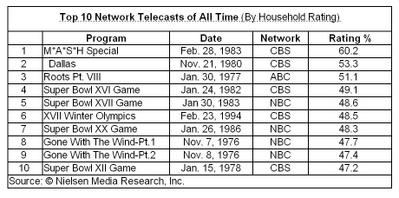
That the make-up and competitiveness of television has changed dramatically since the 1980s can be gleaned in the following list of the ten programs with the highest rating since Nielsen began measuring audiences. Only one of the ten is from the time since the start of the fourth network (Fox) in 1986 and that single event was part of the Winter Olympics from early 1994. Four of the 10 were from the 1970s. Since then, not a single Super Bowl, Word Series game or last episode of a popular series could muster an audience to rival the days of limited choice.

Although I haven’t put together the numbers, I would venture that not one network owner would break into the top 10 even if we added together all their corporate-owned programming-- i.e., broadcast and cable networks -- available at any given hour.


Other data I’ve presented shows that the five largest providers of television programming networks (Viacom, Disney, NBC, Time Warner and News Corp) account for a smaller proportion of television viewership than only three owners of three networks regularly aggregated in the 1960s into the 1980s. This undercuts the notion that fewer owners are controlling what more of us choose to watch, certainly if the comparison point is some supposed “Golden Age” of television a decade or more in the past.

Even though they continue to be profitable despite smaller and smaller audiences, the large media companies know that they need to change and adjust to the changing media mix if they are to survive. That could happen if they didn’t morph as they have been. News Corp, for example, recently announced it was buying Myspace.com and some related Web sites for something close to $600 million. I can’t predict whether that is going to be a good investment or not (I would say “not” unless News Corp has some strategy to keep MySpace from being the hot site du jour, only to be replaced by fickle surfers next year).

But it is possible that if today’s media companies simply try to circle the wagons their future is not guaranteed. I recently was leading graduate students in a Strategic Planning class on a case study (by purchase) of Wal-Mart. Here’s a sobering lesson from that case:

“Of the top 10 discounters operating in 1962 – the year Wal*Mart opened for business—not one remained in 1993.”

Korvette’s, W.T. Grant, Woolco, Zayre, Two Guys, among others had been at the top and were gone. More recently, established chains such as Bradlees, Caldor and Ames have closed their doors, usually not voluntarily. Wal-Mart has learned from their mistakes.

We shouldn’t expect to see media companies—no matter how large or seemingly entrenched—stand pat as the technologies change around them, as consumer behavior adjusts to the choices and broader range of technologies available, and as advertisers follow their customers.

Email this entry
Link to this entry

Thursday, August 18, 2005

"Rebuilding Media" Blog a Welcome Addition as a Forum for Discussing News Media Structure and Mission

I want to call you attention to a new blog has been created at the Corante site called Rebuilding Media. It was organized by two journalists with impressive news and online credentials. Vin Crosbie, a fifth generation news man, was the first director of online publishing at News Corp. Robert Cauthorn is a former vice president of digital media at the San Francisco Chronicle and was the third recipient of the Newspaper Association of America's prestigious Digital Pioneer Award.

As might be expected with the solid journalism background of the co-founders, the emphasis of Rebuilding Media is on the news media-- a subset of the larger media landscape but at the top of the list of types of content for which we are so concerned when we discuss the state of the media industry. While it's certainly important that the First Amendment places few restrictions on broadcasting fluff content, such as the personal live of celebrities, the reason there is such contentiousness about media ownership is that news and information is needed for a democracy to best function, for the civil discourse that so many Americans often take for granted.

The mission statement of the blog holds that
The news media has lost touch with people's needs and interests during the past 30 years, as demonstrated by rapidly declining readership of newspapers and audiences of broadcast news. How we rebuild news media appropriate to the 21st Century from the growing rubble of this industry is the subject of this group weblog.
In a recent entry asking "Are Metro Papers Outdated?, for example, Bob Cathourn writes "that the scale of the metro newspaper has become a central liability of today's press." He continues:
As our cities have grown, metro newspapers evolved with them. That brought a necessary giantism -- giant presses, giant distribution mechanisms, giant staffs. And because of the size of the enterprise, metros require giant advertising revenues to stay afloat.... Perhaps we should now begin asking whether there is a maximum size that a newspaper can achieve before it outgrows its ecosystem and begins to fail its community.
His ideal remedy:

Clearly the lame efforts at zoned editions at metro papers haven't succeeded. Zoning was always more about revenues than coverage anyway.

Let's talk about real structural change instead: partition the giants. Maybe the LA Times should actually be broken into three or four or five distinct papers to better cover the market one giant lumbers across today. If you did it smartly, you could still retain many of the economic benefits of large scale while gaining the focus of smaller organizations.

He doesn't really think that is likely to happen (nor do I think it even adviseable), but he does expect challenges -- and I would add, opportunities-- to the metro papers:
Instead, we should keep our eyes open as multiple, small upstarts -- ala the [San Francisco] Examiner -- arrive to do the local job the metro daily refuses to complete. Add citizen journalism to that mix and you get a spectrum of media that is downright hopeful.
The future of the newspaper is very much on my mind these days. In October I will be making a presentation on the topic to a small group of publishers from around the world and I'm trying to hone my message. Long term trends are very negative, as circulation continues to fall along with advertising lineage. More localism may hold opportunity for some form of media product or service. But it won't reverse the decline of the metro newspaper as we know it.

We need the kind of discussion that is taking place at Rebuilding Media.

Email this entry
Link to this entry

Thursday, August 11, 2005

FCC's DSL Ruling Will Help Spur Competition for Broadband "Last Mile"

There’s been much ink and many bits written about the FCC’s unanimous decision last week largely freeing the telcos to wholesale their DSL service on their own terms—including not at all. This puts them on a level playing field with the cable operators, who were ruled to be freed of such wholesale requirements in the recent Brand X Supreme Court decision.

Those who disagreed with the decision were unusually muted, though still out with their statements. They knew that the outcome was probably inevitable once the Supreme Court had spoken. The non-telco ISPs were predictably displeased, but there was no talk of litigation to overturn the ruling at this point. Earthlink, among the largest resellers of both broadband cable and DSL, at least publicly was nonplused, stating , “…We are confident that we will extend our existing commercial agreements with the Bells so that we can continue to deliver DSL services” and adding, significantly, they will “explore next generation broadband alternatives to give consumers competitive alternatives for their high-speed Internet service.”

The self-styled consumerists were likewise less shrill than I would have expected. (I always call them “self-styled” or “self-appointed” because they rarely seem to be speaking about my self-interest as a consumer and I suspect their positions are rarely, if ever, favorable to the interests of all consumers. I never appointed them to represent me. Nor perhaps you). Andrew Jay Schwartzman, the oft quoted President and CEO of the Media Access Project, a very nice guy with whom I rarely agree on policy, typically lambasted the FCC’s ruling, but added, “Even so, it could have been worse. By asserting its authority to stop the most flagrant kinds of abuse, the FCC has made it somewhat harder to block or impede access to information.”

Indeed, Schwartzman picked up on a generally underreported piece of the FCC’s August 5 Report and Order. Concurrent with the ruling they released a policy statement “New Principles Preserve and Promote the Open and Interconnected Nature of Public Internet,” which states:
(1) consumers are entitled to access the lawful Internet content of their choice; (2) consumers are entitled to run applications and services of their choice, subject to the needs of law enforcement; (3) consumers are entitled to connect their choice of legal devices that do not harm the network; and (4) consumers are entitled to competition among network providers, application and service providers, and content providers.
This addresses the fear expressed by some advocates, as over reported in a Wall Street Journal front page piece (subscription required) on Monday, that “Technology has evolved allowing the broadband companies to block Web sites from their customers.” The industry pooh-poohs that scenario, insisting, they won't ever block access to competitors' Web sites because customers wouldn't stand for it. Regulation freaks (and others with a self-interest) are pushing for Congressional legislation for so-called net-neutrality. Some even acknowledge there isn't a problem now, but say there might be. "The temptation is always there by the owner to favor his own content," the WSJ quotes Rep. Rick Boucher, a Virginia Democrat.

A strong response to this paranoia is in a thoughtful piece by David Berlind, at the Between the Lines Zdnet blog. After first admitting that his initial impulse was to be concerned about an apparent telco-cable duopoly in broadband, Berlind notes:

Recent history is beginning to prove that that technopolies aren't very sustainable and that innovation somehow has a way of breaking them down (although maybe not as rapidly as we'd like). In some ways, trying to keep technopolies at bay through regulation turns out to be a crutch that can only slow innovation down. The innovators are much better off with a less complex labyrinth to deconstruct.
Just recall: In the early 1990s AOL developed what seemed to be an unassailable position as the largest proprietary online service. In 1994 Microsoft launched its competitive MSN. I was part of an active Listserv, On-line News. The preponderance of participants (traditional journalists and new online journalists) agreed that with Microsoft’s hegemony in the PC world that they would quickly overwhelm AOL. Just then the World Wide Web made the Internet an unstoppable force. Despite its near monopoly on the desktop, MSN never got traction as a proprietary service, quickly converting to a free Web service, plus an ISP model that AOL quickly adopted. AOL continued to grow, to the point that it could acquire Time Warner. But with the demise of dial-up service, AOL has been losing subscribers by the millions. Its name was removed from the corporate title, which is again Time Warner.

Similarly, innovators are in the labs and in the field with technologies to compete with the telco and cable guys’ only real competitive barrier—the last mile. Berlind points out that “one big fat digital backhaul to your neighborhood and a wireless mesh can take over from there providing voice (VoIP voice) and data, completely disintermediating the cable/DSL guys in the process.” Entrepreneurs can following the lead of Philadelphia in promoting the build out of city-wide Wi-Fi or use WiMax (though hopefully not as city-owned enterprises). The FCC ruling should give new momentum to the long-running potential of using electric power lines for the last mile.

Both the Brand X decision and the FCC’s rule-making on DSL will likely do more to further broadband competition than a mandatory access ruling ever could have. That would have maintained a cozy two-technology backend duopoly even if many players were doing the marketing on the front end. These decisions are the right ones to encourage truly new technologies that will lead to real competition. Win-win.

Email this entry
Link to this entry

Wednesday, August 03, 2005

And the Largest National Radio Programming Network is....?

Quick: What’s the largest group of uniformly programmed radio stations in the U.S.? Did you say Clear Channel? Wrong. Infinity? Wrong. The answer is….National Public Radio--NPR.

Non-commercial radio has become a major media force. Primarily on the FM band, it has grown faster than the number of radio stations overall. Accounting for 6% of all stations in 1970, public radio stations multiplied in number 560% by 2000 and more significantly more than tripled in proportion to over 20% of all radio stations. Non-commercial radio stations are often affiliated with higher education, municipalities or public television stations.

Their growth has been accompanied by the emergence of National Public Radio as a programming network that rivals the reach of the largest commercial owners. NPR’s most well known programming includes “Morning Edition,” “Fresh Air” and “All Things Considered.” The role of NPR is important in the context of radio competition.

· NPR provides content for much of the programming day on a national basis for the 780 public radio stations it serves.
· Its reach is so pervasive it claims “Just about anywhere you find yourself, you’ll find NPR.” According to NPR’s Web site, “Morning Edition” is the leading morning radio news program in the United States and is the second most listened to radio show nationally. (“All Thing Considered” is number three).
· NPR reaches 26 million listeners on a typical week, double the number of 10 years previously. In the 1980s it claimed an audience of about 2 million weekly.
· Public radio listeners outnumber the combined circulation of the top 35 U.S. daily newspapers.

For comparison, the nationally syndicated talk show of political commentator Rush Limbaugh has a weekly audience of between 15.5 and 20 million on about 600 stations.

With 99% of the U.S. in range of one or more NPR stations, virtually all Americans have a very differentiated choice should they seek an alternative to the music, talk, news, religious or other programming choices in their area.

What’s curious (well, not really-- I’m not surprised) is that media industry critics do not seem to complain about the common programming that emanates from NPR’s Washington, DC headquarters. Whether in Minot, ND or Los Angeles or Baton Rouge or Bangor, there is little local news or information being transmitted during the highest listening times of the day on NPR-affiliated radio stations. Whether broadcasting “Car Talk” or “World Cafe,” it is the same programming everywhere.

Don’t get me wrong here—NPR has some quality programming. I think it’s great that it’s available nationally. My point is that when the high decibel critics take on a commercial radio chains for programming out of some central facility for many of their stations around the country (which is far less common than they suggest) but don’t criticize the NPR-affiliated public station network, they expose their real bias. And that is that they just don’t like the programming that the commercial stations provide. If Infinity produced the NPR schedule I suspect they would have to be silent. When you look beyond the rhetoric on media ownership structure, what many of the angriest and most active of the self-styled media reformers really want is media that will provide content they think the audience “should” have: NPR for everyone, all the time. What we have now is choice—to listen to Rush or Neal, Al or Bill.

Works for me—and most others as well.

E-mail this entry
Link to this entry

(Note: In the original version of this entry I included "A Prairie Home Companion" as being an NPR program. Rather it is a program of American Public Media, the other major national programming service for public stations, with primary headquarters in Minneapolis.)

Tuesday, July 26, 2005

Media Content is Becoming More Complex, More Socially Involving

So much of what critics of media industry structure harp on is how the big media players dumb down the media. They’re only interested in earnings, goes the litany, so they pander to the lowest common denominator. We are becoming a nation of couch potatoes. Video games teach violence and take kids away from what they should be doing after school—homework and watching C-Span.

Now along comes a book, from an author with solid credentials and no obvious political agenda, that turns these arguments on their head. The best of television today is far more engaging, complex, and brain exercising than television has ever been before. Even the lower rungs of programming are better than the their equivalents 10 or more years ago. The best selling video games, it turns out, are those that stimulate the most thinking and involvement. The Internet augments and magnifies the richness of other media. In essence “Everything Bad is Good for You: How Today's Popular Culture is Actually Making Us Smarter,” the title of Steven Johnson's latest book.

As you are among a small self-selected audience that is reading this Blog, you may already be of a predisposition to have read Johnson’s book. If not, you will be at a huge disadvantage in any discussion of media ownership and structure. Because one of Johnson’s central tenets is that the content of the mass media has risen to new highs in narrative structure, in sophistication and intellectual development because of the increase in competition among the media. He makes a convincing argument that the marketplace—economics—is one of the major forces driving the change (the changing neurology of the brain and changing technology platforms are the other two).

Johnson develops his themes through 210 fast paced pages, so I cannot do them justice in this brief entry. But here are a few of his assertions—all backed by substantive exposition:

• He has dubbed his most central argument The Sleeper Curve—after the 1973 movie in which Woody Allen’s character in Sleeper awakes 100 years in the future where he finds chocolate has been determined to be a health food. In similar fashion, Johnson holds that today’s most debased forms of mass culture—video games, television drama and sitcoms—turn out to be “nutritional after all.”

For decades, we’ve worked under the assumption that mass culture follows a steadily declining path toward lowest-common-denominator standards, presumably…because big media companies want to give the masses what they want. But in fact, the exact opposite is happening: the culture is getting more intellectually demanding, not less.

• Johnson compares television's popular dramas of the 1970s and 1980s, such as Dallas and the groundbreaking Hill Street Blues and St. Elsewhere, with today’s dramas, such as The West Wing, The Sopranos and 24. The latter group have substantially more multithreaded plots, a larger number of regular characters, more sophisticated relations among the characters and fewer obvious “flashing arrows” to tell viewers what’s important and what’s ephemeral. Viewers have to deal with far more ambiguity and fill in many more blanks around the plots than in the old narratives. In short, they have to think far more as they watch and after each episode ends.

The reason that these newer narrative forms are so attractive to the producers is that, like a good book, they reveal themselves further with repeated viewings. Viewers of Seinfeld, the successful situation comedy, find nuance, references to long ago plots and similar discoveries on second and third viewings. Thus, producers have found that the syndication value of these programs is enhanced because repeated viewing is actually sought after by the audience. Moreover, DVD sales of these programs are a new source of revenue precisely because they stand up to repeated viewing. Johnson calls this model MRP—Most Repeatable Programming. This replaces the old model from the days of only three networks, LOP—Least Objectionable Programming. Which stands up better to repeated viewing, Happy Days or Friends?

Even the programming that is often derided as crass, such as the reality shows, has redeeming qualities far in excess of the programming of yore, such as The Price is Right. "The Apprentice may not be the smartest show in the history of television, but it nonetheless forces you to think while you watch it, to work through the social logic of the universe it creates….” People actually discuss the strategies used by contestants on the reality shows. “You don’t zone out in front of shows like The Apprentice. You play along.” Apple’s Steve Jobs calls this type of media “sit foward,” rather than the "leaning back" media that characterized most television programming in the past.

Johnson’s conclusion is that “dumbing down” is not the natural state for popular culture. It is just the opposite. Like the overlooked trend of increased media competition rather than less, in media-mediated culture far more trends are pointing up. It’s a state of affairs that even a cultural elitist should support.

Email this entry
Link to this entry

Wednesday, July 13, 2005

U.S. Has Most Diverse Media "in the World" Concludes Canadian Research Scholar in Harvard Study

In most industries the central concern about the degree of competition is economic: the degree of pricing power that the players have. For the most part, the agenda behind the contentious issue of media ownership policies centers not on prices but around diversity of content. Except for the occasional mention of allegedly unchecked cable rates, we don’t hear people complaining about the pricing of newspapers, magazines, or, heavens knows, Internet access or content.

No, media ownership debates are at heart a surrogate for the degree of choice that viewers and readers and listeners have. That is why the F.C.C. made a valiant, if controversial, attempt to construct a “diversity index” as a piece of its supporting documentation for its ownership regulation policies.

As the debate over the F.C.C.’s index reminded us, the quantification of “diversity” does not lend itself to easy metrics. Is it measured by different formats (print, audio, online)? Different genres (comedies, news, documentaries, dramas)? Languages (available in English, Spanish, Serbo-Croatian)? By “voices” (number of different owners)? Does audience size matter? If there are 1000 equally accessible voices but 80% of the audience at any moment or any day chooses to watch/read/listen to 1% of them, does that mean there is less diversity than if the audience was equally divided among all 1000 voices/owners?

In my media myths study (see link at right) I address this to a point, citing in particular research by Mara Einstein, who found by one approach to diversity that under the F.C.C. network rules in the 1970s and 1980s, designed to promote diversity, actually lessened it. But that looks at only one piece of the elephant.

Now along comes a new study conducted at Harvard's Kennedy School, “Measuring Media Diversity: Problems and Prospects” that, as its title promises, quite successfully lays out the problems involved in grappling with a definition of media content diversity. This is a concept that its author, Richard Schultz, characterizes as a “conceptual bog.” One intriguing aspect of this study is that it was compiled by a Canadian who is a senior member of the faculty of Montreal’s McGill University. Thus, the perspective is a bit less incestuous than an American who has been immersed in the U.S.-centric debates for years. And it is from this perch that he can make this initial observation:
No country arguably has had a more explicit commitment to the promotion and preservation of media diversity than the United States. Some scholars date the adoption of diversity as a goal of public policy in the United States to the 1879 Postal Act which provided for subsidized postal rates for magazines.
Schultz’s paper explores the “meaning of media diversity and the complications that conceptualizing media diversity pose for developing a non-contestable, if such is possible, measurement system.” He parses the controversy around the F.C.C.’s attempt to develop its Diversity Index. But in my entry today I will skip down to his findings and conclusions.

First, he summarizes that “the United States today already has one of, if not the most diverse media universes, perhaps galaxies is the better word, in the world. Those who argue the opposite simply have not shown ‘the beef’.” Then he nails the real issue:
The critics are more concerned about the quality, or lack thereof, in American media and the fact that for the most part it is commercial and market-driven… In part the issue is not diversity per se or even diversity of owners but rather diversity of types of owners. The critics just don’t like corporate domination of the media….
Clearly I agree with Schultz. But here is someone who is looking at the issue from the outside and sees without blinders the implications of what the media ownership critics really want: not more choice but less. They want owners who will not give us the choice of the "O’Reilly Factor," "C-Span" or "60 Minutes," but three channels of C-Span. Their choices for films would not be “Batman Begins” “Chocolat” or “Dumb and Dumber” but ten flavors of Michael Moore. What they seem to want is not our choices but their choices.

Democracy is not just about politics and government. It is about voting -- choosing -- in our daily lives. Democracy can be and has been sloppy: we have not always made the most enlightened choices. But they are our choices. The same holds for the choices we make about what media-provided content we consume. I recommend Richard Schultz’ analysis for your open-minded consideration.

Schultz expects that his paper will be available online soon. I will provide a link when it is.

Email this entry
Link to this entry

Wednesday, July 06, 2005

Penn State Study Finds Media Diversity Fostered by Vigorous Media Entrepreneurship

A new body of research just being developed appears to support the contention that the media industry is being driven by upstart entrepreneurs rather than by the staid big media companies. The research is in a formative stage. But if further work supports the findings to date it would bode well for the diversity and quality of the media.

The research has been lead by Anne Hoag at the School of Communications at Penn State (and a colleague during my brief stay there). She teaches a course called Entrepreneurship in the Information Age. She recently presented a paper, “Media Entrepreneurship: Definition, Theory and Context,”at Babson College's entrepreneurship conference.

Hoag found that “media entrepreneurship appears to be relatively dynamic and healthy compared to all U.S. industries – on average the media industry was more turbulent during the 1990s and had more nascent entrepreneurship at the turn of the 21st century.” Turbulence is considered healthy in the entrepreneurship literature, as it suggest vibrancy—new entrants coming in, others closing down. This stands in contrast to the 1950s through the early 1990s, when trends in organizations per capita showed that media entrepreneurship overall was rather stable.

Her research did not find that media entrepreneurship was equal in all segments. As might be expected, the older, mature publishing sector showed the least activity. Activities associated with visual productions—theatrical film, television production and the like -- were the most active.

Prof. Hoag’s paper opens with a general observation:

Recent scholarship has shown that new and small firm growth and a corresponding decline in conglomeration and concentration starting in the 1970s has shifted the source of economic growth and innovation toward the entrepreneurship and small business sector. In fact, new firms have been shown as the main source of net job growth.

Then she asks:

Does the evidence support such a claim when applied to media industries? In particular, does it hold up when the term “innovation” is translated into media industry performance concepts like diversity (in content and voices), access (to the media and communication networks for the public), quality (in both content and access technologies) and new processes with democratizing effects.

This line of inquiry is important because it can add empirical data to the work that already shows the ferment in the media industry. The headlines announcing any big media merger sticks in the minds of viewers and readers, seeming to support the perspective of big media getting more powerful. The reality is just the opposite, as can be seen in articles and research here, here and here.

Hoag has opened a useful line of inquiry. You can follow her reserach at her new blog.

Email this entry
Link to this entry